
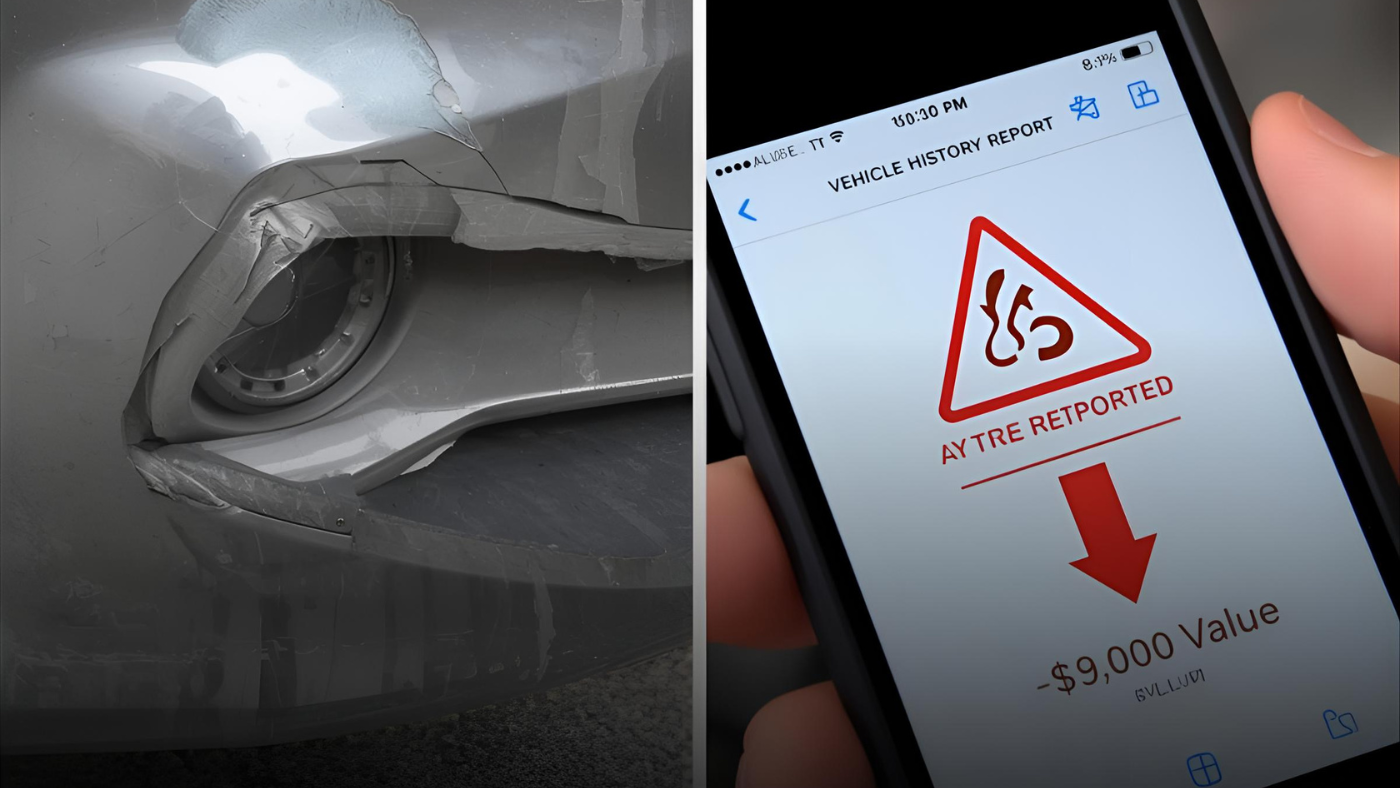
It was a minor fender bender. I was stopped at a red light, and the guy behind me didn’t stop. Thump.
His insurance accepted liability immediately. They were great. They paid for a rental car, sent me to a certified body shop, and two weeks later, I got my car back. It looked brand new. The paint matched perfectly. There wasn’t a scratch on it.
I thought the ordeal was over.
Six months later, I decided to trade the car in for a newer model. I went to the dealership, expecting to get the Kelley Blue Book trade-in value of $22,000.
The dealer ran the VIN number, frowned, and handed me a printout. “We can only offer you $18,000,” he said.
“Why?” I demanded. “It’s in perfect condition!”
He pointed to a line on the Vehicle History Report (Carfax): ACCIDENT REPORTED.
“It doesn’t matter that it was fixed,” he explained. “Nobody wants to buy a wrecked car. We have to mark it down to sell it. So we have to pay you less.”
I was stunned. The other driver’s insurance had paid to fix the bumper, but they hadn’t paid me for the $4,000 in value my car lost just by having a “bad record.”
I went home angry and started researching. That’s when I discovered the insurance industry’s best-kept secret: The Diminished Value Claim.
What is Diminished Value?
When your car is in an accident, it suffers two types of damage:
-
Direct Damage: The bent metal and broken glass. (Insurance pays for this automatically).
-
Inherent Diminished Value: The loss of market value because the car now has an “accident history.”
Think about it: If you see two identical cars for sale, but one has an accident on its record, which one would you buy? The clean one. To sell the wrecked one, the seller has to lower the price.
The Law: In many states (though not all), the at-fault driver’s insurance is legally required to compensate you for this loss of value. But they will never offer it voluntarily. You have to demand it.
The “Automatic Denial” Game
I called the at-fault driver’s insurance company again. “I want to file a Diminished Value claim,” I said.
The adjuster laughed. “We repaired your vehicle to industry standards. We don’t owe you for market speculation.”
This is the standard script. They deny these claims 99% of the time hoping you will go away. But I knew I had lost $4,000, and I wasn’t going to let it go.
How I Won My Check (Step-by-Step)
I realized I couldn’t just argue. I needed proof. Here is the exact process I used to force them to pay.
Step 1: I Got a “Post-Repair Inspection”
I hired an independent certified auto appraiser (not the body shop). I paid him $250 to inspect the car and write a formal report stating:
-
The repairs were done correctly.
-
The car has still lost $4,100 in value due to the accident history stigma.
Step 2: The Demand Letter
I sent a certified letter to the insurance adjuster. I didn’t write a sad story; I wrote a legal demand.
“Enclosed is a certified appraisal establishing the Inherent Diminished Value of my vehicle at $4,100. Since your insured driver is liable for all my losses, I demand payment of this amount within 30 days.”
Step 3: The Negotiation
They called back. They offered me $1,000 to “make it go away.” I said no. They offered $2,500. I said no. I sent them listings of similar wrecked cars selling for thousands less than clean cars.
Finally, they sent a check for $3,800. I accepted. After paying the appraiser, I cleared $3,550.
When Can You File This Claim?
Before you run to the phone, know that this doesn’t work for every accident. The 3 Rules of Diminished Value:
-
You CANNOT be at fault: If you caused the crash, your own insurance usually excludes this (unless you live in Georgia). You can only claim this against someone else’s insurance.
-
The car must be newer: If your car is 10 years old and has 150,000 miles, it didn’t have much value to lose. This works best on cars under 5 years old.
-
No prior accidents: If your car was already wrecked once before, you can’t claim it lost value again. It needs to have been “clean” before this crash.
Conclusion: Don’t Leave Money on the Table
Insurance companies save millions every year because people like me (and you) don’t know this claim exists.
If you have been in an accident in the last 2-3 years (yes, you can often file retroactively!), check your state laws. You might have a $3,000 check waiting for you.
Don’t let them tell you “we fixed the car.” Fixing the car is only half the job. Making you whole means paying for the Value too.