
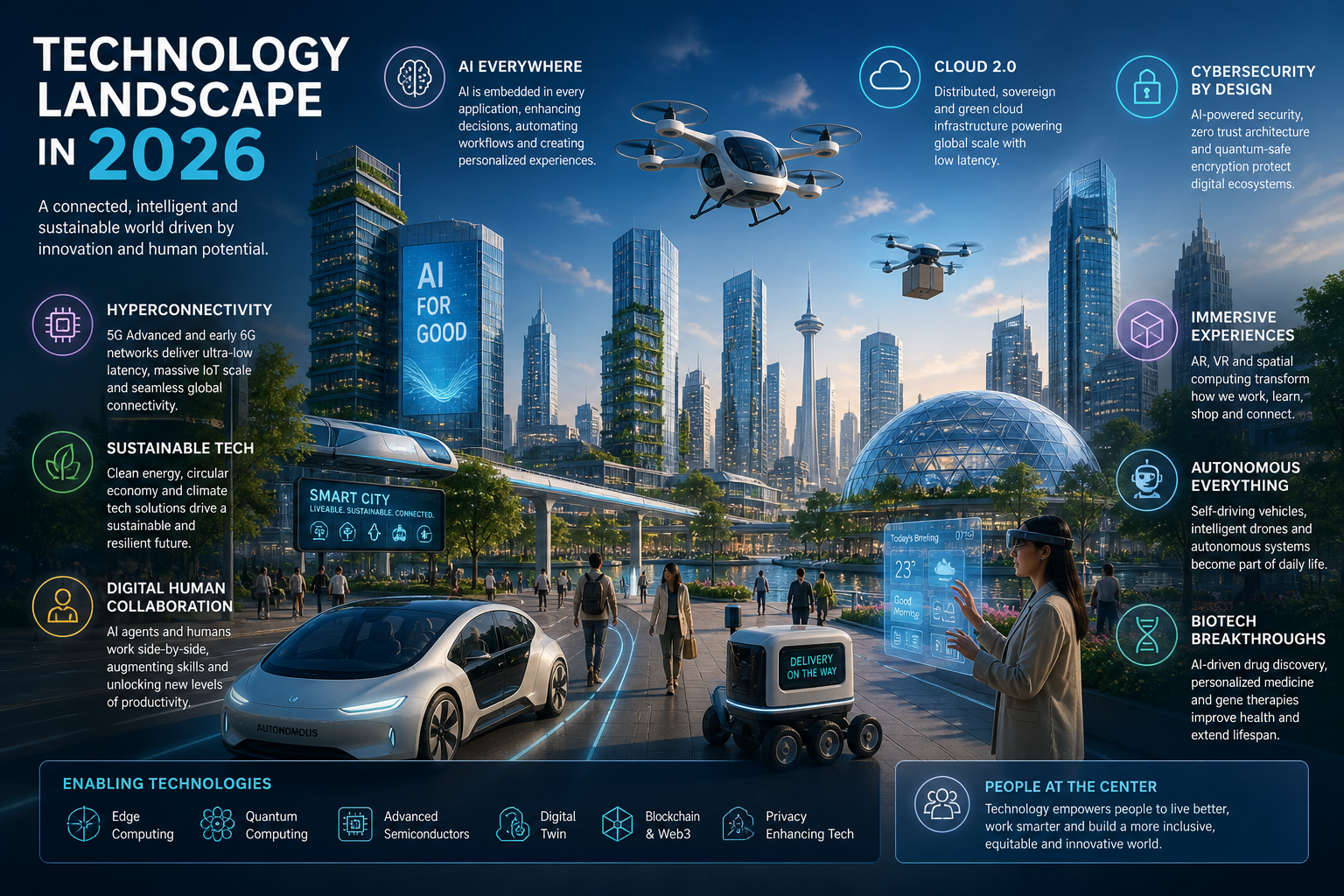
We’re living through what historians may one day call the most compressed period of technological transformation in human history. Five billion-plus people are connected to a global digital fabric. Twenty billion devices exchange data around the clock. And the systems running on top of that fabric — AI, quantum hardware, spatial interfaces, autonomous agents — are no longer experimental. They are operational.
But “operational” doesn’t mean simple. Most technology coverage in 2026 falls into two camps: hype that overstates what’s ready, and dismissal that underestimates what’s quietly becoming infrastructure. This article tries to occupy the space between — giving you an accurate, grounded picture of where the major technology shifts stand today, what problems they’re actually solving, and what you need to understand to navigate them intelligently.
Part One: Artificial Intelligence — From Assistants to Agents
The shift that changes everything
For three years following the public launch of large language models, the primary metaphor for AI was a chat window. You typed. It responded. You read, edited, and acted.
That metaphor is now obsolete.
The defining shift in AI in 2026 is the move from generative models that produce content to agentic systems that take action. An AI agent doesn’t just answer a question — it perceives a goal, decomposes it into steps, uses tools to execute those steps, evaluates outcomes, and iterates. It acts in the world rather than responding within a conversation.
This transition is not theoretical. According to Gartner, by 2026, over 80% of enterprises will have deployed some form of autonomous AI agents in production environments. The infrastructure that supports this — APIs, cloud orchestration platforms, tool-calling frameworks — is already in place. What’s catching up is governance, security, and organizational literacy about what these systems can and cannot safely do.
What agentic AI actually does today
Concrete examples cut through the abstraction. Here is where autonomous AI agents are deployed at scale right now:
Software engineering pipelines. GitHub’s chief product officer, Mario Rodriguez, describes 2026 as the moment of “repository intelligence” — AI that understands not just individual lines of code but the entire relational context of a codebase: what changed, when, why, and how pieces fit together. This allows agents to catch errors earlier, suggest fixes with full context, and automate routine maintenance tasks that previously required developer attention.
IT operations and system monitoring. A 2026 Dynatrace report found that 70% of surveyed organizations are using AI agents in IT operations and system monitoring, with nearly half running them across both internal and external use cases. These agents handle alert triage, anomaly detection, and incident response with less human-in-the-loop intervention than even two years ago.
Deep research and intelligence. Deep Research Agents — autonomous systems that can gather data from multiple sources, cross-verify facts, and produce structured analytical outputs — are increasingly deployed in finance, healthcare, legal research, and defense. The distinction from earlier AI tools is continuity: these agents run unattended over hours, not seconds.
Customer support and workflow automation. Multi-agent systems — networks of specialized AI agents that hand off tasks between each other — are replacing linear automation scripts in large enterprises. A customer query about an invoice, for example, might be processed by one agent that reads the account, another that checks payment status, another that drafts the response, and a fourth that decides whether to escalate. No human is involved until escalation.
The security problem nobody solved first
The same features that make agentic AI powerful — persistent access, tool use, memory across sessions, multi-agent coordination — also expand the attack surface dramatically.
CISA issued guidance in late 2024 warning that agentic AI systems operating with persistent access to enterprise resources represent a new and expanding attack surface that existing endpoint and perimeter defenses were not designed to address. By 2026, that warning has materialized into documented incidents.
The threat vectors are specific. Prompt injection attacks — where malicious content in the environment manipulates an agent’s behavior — are the most common. Tool misuse and privilege escalation are the most frequently reported incidents in 2026 enterprise security data, with 520 documented cases in one study alone. Memory poisoning, where an agent’s stored context is corrupted to alter future behavior, is less common but carries disproportionate impact when it occurs.
IBM’s 2025 Cost of a Data Breach Report found that organizations using AI extensively in security operations saw breach costs averaging $4.88 million per incident. The irony — AI deployed to protect systems creating new vectors for breach — reflects the broader pattern of transformative technology: capability and risk scale together.
The organizations best positioned in this environment treat AI agents exactly as they treat other privileged systems: least-privilege access, strict network segmentation, behavioral monitoring, and regular adversarial testing.
The efficiency turn: smaller models, smarter hardware
A counterintuitive shift is happening alongside the agent revolution. Contrary to the assumption that AI progress means ever-larger models requiring ever-more compute, the frontier in 2026 is efficient intelligence.
IBM’s Principal Research Scientist Kaoutar El Maghraoui describes 2026 as “the year of frontier versus efficient model classes.” On one side: massive models with hundreds of billions of parameters that require GPU clusters to run. On the other: small, hardware-aware models that run on modest accelerators — at the edge, on devices, in specialized chips — delivering high-quality inference at a fraction of the cost.
The hardware race reflects this. While Nvidia’s H200, B200, and GB200 chips drive scale-up workloads, ASIC-based accelerators, chiplet designs, and analog inference hardware are maturing for scale-out deployments. The vision, as Mark Russinovich of Microsoft Azure describes it, is AI infrastructure that functions like air traffic control — routing workloads dynamically across distributed networks so no compute sits idle.
The practical implication: AI capability is becoming a commodity. The competitive advantage in 2026 is not having the most powerful model. It’s deploying intelligence efficiently, close to data, with the right governance in place.
Part Two: Quantum Computing — From Promise to Strategic Priority
Where quantum actually stands in 2026
Quantum computing has occupied a strange position in technology coverage for a decade: perpetually promising, perpetually “five years away.” That characterization is now imprecise in both directions.
Quantum computers are not ready to replace classical systems. The idea of a near-term quantum apocalypse that instantly breaks encryption or disrupts financial markets is not grounded in the current state of hardware. But the characterization of quantum as purely theoretical is equally wrong. Real progress is happening, real money is moving, and real organizations are making strategic decisions about quantum readiness.
IBM has publicly stated that 2026 marks the point at which a quantum computer will outperform a classical computer on at least one class of problem — what the field calls “quantum advantage.” McKinsey’s Quantum Technology Monitor 2026 describes this as the year quantum computing transitions from a management curiosity to a strategic imperative. The report notes that global investment in quantum technology start-ups reached $12.6 billion in 2025 — a tenfold increase from the previous year — with private investors and capital markets replacing government as the dominant funding source.
That capital shift is significant. Government-led research funding reflects scientific interest. Private capital reflects commercial expectation.
How quantum computers actually work (and why it matters)
Understanding the architecture helps explain both the potential and the current limitations.
Classical computers store information as bits — each bit is either 0 or 1. Quantum computers use qubits. A qubit can be 0, 1, or — through a property called superposition — any value between the two simultaneously. Additionally, qubits can be “entangled,” meaning the state of one qubit is instantaneously correlated with another, regardless of physical distance. These properties allow quantum systems to explore enormous solution spaces simultaneously, rather than testing possibilities sequentially.
The practical implication: certain classes of problems that would take a classical supercomputer years to solve could, with a sufficiently powerful and stable quantum computer, be solved in hours or minutes. Those problem classes include molecular simulation, cryptographic factoring, portfolio optimization, and certain machine learning algorithms.
The constraint is stability. Qubits are extraordinarily fragile. Interference from heat, vibration, or electromagnetic noise causes “decoherence” — the qubit loses its quantum state and becomes a classical bit. Current hardware operates in “noisy intermediate-scale quantum” (NISQ) conditions, meaning errors accumulate and must be corrected.
Microsoft’s Majorana 1 chip — the first quantum chip built using topological qubits — represents a significant architectural step toward error correction. Topological qubits are inherently more stable than conventional designs because their quantum information is encoded in the shape of the qubit rather than a single fragile physical state.
The road to fully fault-tolerant quantum computing remains measured in years, not months. But the trajectory is no longer in doubt.
What quantum computing will actually disrupt first
Not every industry faces equal exposure to quantum’s near-term capabilities. Some sectors are already preparing; others have time. Understanding which is which avoids both panic and complacency.
Drug discovery and materials science. Quantum computers can simulate molecular interactions at a level of accuracy that classical computers cannot achieve without approximation. This matters enormously for pharmaceutical research, where simulating how a drug candidate binds to a protein target is a computationally intensive problem that currently takes months. Quantum simulation could compress that timeline dramatically. IBM and MIT’s joint computing research lab — launched in April 2026 — is specifically focused on applying quantum-AI hybrid approaches to scientific breakthroughs.
Cryptography and cybersecurity. This is the most urgent near-term concern for enterprises. Many current encryption systems — RSA, Elliptic Curve Cryptography — rely on the mathematical difficulty of factoring large numbers. A sufficiently powerful quantum computer could break these systems. The window before that becomes practical is uncertain but not indefinitely distant. The National Institute of Standards and Technology (NIST) finalized its first post-quantum cryptographic standards in 2024. Organizations with sensitive long-lived data — government agencies, financial institutions, healthcare systems — should already be assessing their exposure and planning migration to quantum-resistant encryption.
Financial optimization. Portfolio optimization, risk modeling, and fraud detection involve the kind of combinatorial mathematics where quantum systems offer genuine advantage. JPMorganChase researchers have already demonstrated a quantum streaming algorithm that achieves what is described as exponential space advantage in processing large datasets in real time.
AI acceleration. Quantum machine learning remains largely theoretical at scale, but the convergence is coming. IBM’s quantum-centric supercomputing architecture combines quantum hardware with classical CPUs, GPUs, and AI models — a hybrid approach that uses each paradigm where it excels rather than forcing quantum to replace classical computing wholesale.
The geopolitical dimension
Quantum computing has become as much a geopolitical contest as a scientific one. The United States leads in quantum start-up financing — capturing 64% of global investment. Europe leads in enterprise adoption of quantum technology by companies. China leads in research publications and patent applications, driven by aggressive state-led investment programs.
The strategic stakes are clear: whichever nations and institutions develop reliable quantum advantage first will hold asymmetric advantages in cryptography, intelligence, drug development, and materials science. Henning Soller of McKinsey puts it directly: “The window of opportunity to achieve a leading position in the quantum economy is already closing.”
For technology leaders in enterprise, the practical takeaway from McKinsey’s analysis is that quantum computing is no longer a question for R&D departments alone. It belongs on the strategic agenda. Not because quantum systems are ready to deploy at scale today, but because the decisions made in 2026 — about cryptographic infrastructure, talent pipelines, vendor partnerships, and pilot programs — will determine competitive positioning when utility-scale quantum arrives.
Part Three: The Hardware Revolution Nobody Is Talking About Enough
Chips, architecture, and the end of Moore’s Law as we knew it
For fifty years, computing power roughly doubled every two years — a trend known as Moore’s Law, named for Intel co-founder Gordon Moore who observed it in 1965. The mechanism was simple: transistors got smaller, more fit on a chip, and performance improved almost automatically.
That mechanism is exhausted. Physical limits on transistor miniaturization have ended the era of free performance gains through shrinking. The industry response has been architectural: instead of making individual processors faster, design systems that distribute work more intelligently across specialized hardware.
This shift explains the landscape of hardware in 2026:
GPUs become the baseline, not the premium. Graphics Processing Units, originally designed to render video game visuals, turn out to be extraordinarily well suited for the parallel matrix mathematics that powers AI. The explosive demand for AI training and inference has made Nvidia the most valuable semiconductor company in history. But GPU dominance is being challenged from multiple directions.
ASICs replace general-purpose chips for specific workloads. Application-Specific Integrated Circuits — chips designed to do one thing extremely well — are replacing GPUs for many inference tasks. Google’s Tensor Processing Units (TPUs), Anthropic and Amazon’s Trainium chips, and a growing ecosystem of AI accelerators all represent the same strategic insight: for defined, repetitive workloads, purpose-built hardware beats general-purpose hardware on efficiency by large margins.
Chiplet architectures enable modular design. Rather than designing one massive chip, chiplet architectures assemble multiple smaller chips — each optimized for a specific function — on a single package. This approach reduces manufacturing yields (it’s easier to make small chips without defects than large ones) and allows mixing and matching of compute, memory, and I/O components.
Edge hardware brings intelligence to data. One of the most consequential — and under-covered — hardware trends is the maturation of edge computing: performing computation where data is generated rather than shipping everything to centralized data centers. Smart shelves in retail, computer vision in manufacturing quality control, autonomous medical monitoring at the patient bedside — all of these require computation that is fast, energy-efficient, and local. A new generation of edge chips and edge AI accelerators is enabling this.
The energy problem and why it reshapes everything
AI’s energy appetite is extraordinary. Training a single large language model can consume more electricity than a small city uses in a year. Running that model at scale — serving millions of queries daily — requires infrastructure that major cloud providers are racing to build.
This creates a direct collision with sustainability commitments. Microsoft, Google, and Amazon have all made net-zero pledges. All three are simultaneously building massive new data centers to meet AI demand. The resolution of this tension is not yet clear.
What is clear is that energy efficiency is no longer just an engineering metric — it’s a competitive and regulatory constraint. Organizations designing AI infrastructure in 2026 must account for carbon footprints, power purchase agreements, and the geographic availability of renewable energy. Some are exploring the use of nuclear power for data centers. Others are investing in analog and neuromorphic computing approaches that perform inference at dramatically lower energy cost.
Part Four: Cybersecurity in the Age of AI — A Two-Sided Arms Race
Why 2026 is a defining year for digital security
Every significant technology shift produces a corresponding security challenge. The internet produced network intrusion. Mobile produced a new generation of endpoint vulnerabilities. Cloud produced misconfiguration and identity-based attacks. AI is producing something more complex: an arms race in which both defenders and attackers are deploying AI simultaneously.
On the defensive side, agentic AI enables capabilities that human security teams could never match at scale: continuous monitoring of millions of events simultaneously, autonomous incident response that contains threats in seconds rather than hours, adaptive threat hunting that identifies novel attack patterns before they’re known, and fraud detection that processes transaction data at a speed and granularity impossible for humans.
Global AI spending in cybersecurity is projected to grow from $24.8 billion in 2024 to $146.5 billion by 2034 — a compound annual growth rate that reflects the urgency organizations feel.
On the offensive side, the same capabilities are being exploited. AI-assisted phishing attacks are more convincing and personalized than anything possible manually. AI-generated malware adapts to evade detection. AI-powered reconnaissance can map an organization’s attack surface faster than human red teams.
The Verizon 2025 Data Breach Investigations Report documented a sharp rise in attacks targeting automated systems and API-connected workflows — exactly the infrastructure that agentic AI depends on. The lesson: as organizations add intelligent automation, each automated system becomes a potential attack vector.
The identity crisis at the center of modern security
If there is a single thread connecting the majority of significant security incidents in 2026, it’s identity. Not malware. Not network intrusion. Compromised or abused credentials.
The shift to cloud, remote work, and now AI agents has created an explosion in the number of identities an organization must manage — not just human users, but service accounts, API keys, machine identities, and now AI agents that themselves act as authenticated principals with access to systems.
Zero-trust architecture — the principle that no identity, device, or network segment is trusted by default, and every access request must be verified — has moved from a security recommendation to a baseline expectation. Organizations without zero-trust frameworks are disproportionately represented in breach reports.
For AI agents specifically, the security principle is least-privilege access: agents should have exactly the permissions required to complete their assigned task and nothing more. An AI agent managing calendar scheduling should not have write access to financial systems. The principle sounds obvious; the implementation requires deliberate architectural decisions that many organizations have not yet made.
Post-quantum cryptography: why the clock is running
One of the most consequential — and underappreciated — security decisions organizations face in 2026 is when to begin migrating to post-quantum cryptographic standards.
The threat is sometimes framed as distant: quantum computers powerful enough to break current encryption don’t exist yet. But the relevant horizon isn’t “when can a quantum computer break RSA today?” It’s “when will adversaries be able to decrypt data they’re collecting now?”
State-level actors with interest in sensitive communications — intelligence services, government agencies, foreign adversaries — are almost certainly collecting encrypted data now with the intention of decrypting it once quantum hardware matures. For data with long-term sensitivity — personal health records, national security information, long-lived financial agreements — the window to migrate is not comfortably distant.
NIST’s post-quantum standards, finalized in 2024, provide the cryptographic foundation. The migration itself is complex, time-consuming, and requires coordination across software vendors, hardware manufacturers, certificate authorities, and internal systems. Organizations that begin now will have completed the transition before quantum risk becomes acute. Organizations that wait will face it under pressure.
Part Five: The Spatial and Physical Turn
Computing escapes the screen
For the better part of six decades, human interaction with computers has been mediated by a screen. The graphical user interface, invented at Xerox PARC and commercialized by Apple, remains the dominant paradigm. You look at a rectangle. You click, type, or tap within its boundaries. The computer responds by updating the rectangle.
Spatial computing challenges this paradigm at its foundation. Defined as the convergence of digital content with the physical world, spatial computing allows digital objects, data, and experiences to be anchored in three-dimensional space and interacted with naturally. It uses computer vision, sensors, AI, and increasingly wearable displays to make the boundary between physical and digital environments permeable.
The technology exists today in multiple forms: augmented reality overlays in industrial settings, mixed reality collaboration tools that allow remote teams to share a virtual workspace, and consumer wearables that are gradually becoming capable enough to sustain daily use.
The industrial applications are the most immediately impactful. A technician servicing complex equipment can see repair instructions superimposed directly on the machine. A surgeon can view patient scan data in the operating field without looking away from the patient. A warehouse worker can navigate fulfillment efficiently by following visual cues in their field of vision rather than consulting a handheld device.
Humanoid robotics cross from laboratory to factory floor
The robotics story of 2026 is not about robots replacing all human labor — a panic that has been misfiring for fifty years. It’s about robots crossing a specific threshold: becoming capable of operating in unstructured environments designed for humans.
For decades, industrial robots were fixtures: large, powerful machines bolted to the floor, programmed to perform exactly one task with millimeter precision. They couldn’t adapt, couldn’t navigate an irregular workspace, and required extensive protective infrastructure to operate around humans.
The new generation of humanoid and semi-humanoid robots can move through ordinary spaces, pick up irregular objects, learn by observation, and operate alongside human workers. Multiple major manufacturers — Tesla, Boston Dynamics, Figure AI, and Chinese competitors — have moved from demonstration videos to production deployments in 2025 and 2026.
The sectors being disrupted first are not the ones most commonly feared. The initial deployment wave is in environments humans find hazardous, physically demanding, or tedious: warehouse fulfillment, factory inspection, hazardous material handling, and agricultural harvesting.
Brain-computer interfaces: the long horizon that’s getting shorter
Brain-computer interfaces (BCIs) — direct communication channels between the brain and computing systems — remain early-stage, but the trajectory has shifted from science fiction to early clinical reality.
Neuralink received FDA approval for its first human trials in 2023 and has since expanded its implantable device trials, with early participants demonstrating the ability to control computers with thought alone. Competing approaches from companies like Synchron are pursuing less invasive architectures.
The near-term applications are overwhelmingly medical: restoring motor function to people with paralysis, enabling communication for those with ALS or locked-in syndrome. The longer-term horizon — cognitive augmentation for neurologically typical people — remains distant and ethically complex.
For technology strategists, BCIs sit in a category worth monitoring but not immediately incorporating into near-term planning. The regulatory path is long, the safety evidence base is still forming, and the commercial applications outside medical use are speculative.
Part Six: AI for Science — The Quiet Revolution with the Largest Stakes
When AI accelerates discovery itself
Among all the applications of AI in 2026, the one with the greatest potential long-term impact is the least visible to most people: AI applied to scientific research itself.
DeepMind’s AlphaFold transformed structural biology when it accurately predicted the three-dimensional structure of virtually every known protein. Before AlphaFold, protein structure determination was among the most laborious tasks in biology — years of work for a single protein. AlphaFold produced 200 million protein structures in months.
This is not just a productivity gain. It changes what science can ask. Questions that couldn’t be investigated because the data didn’t exist are now investigable. Drug targets that couldn’t be visualized are now visible. Disease mechanisms that were opaque are now at least partially legible.
The pattern is repeating across scientific domains. AI systems are accelerating materials discovery — finding new alloys, polymers, and compounds with specific properties by exploring molecular space computationally rather than through trial and error. Climate modeling is becoming more accurate. Drug combination optimization — an impossibly large search space for human researchers — is tractable for AI.
The convergence of AI and quantum computing amplifies this further. MIT and IBM’s Computing Research Lab, launched in April 2026, is explicitly targeting scientific breakthroughs at the intersection of AI, algorithms, and quantum systems — applying the combination where each technology’s strengths compensate for the other’s limitations.
What this means for human researchers
The most useful framing is not “AI replaces scientists” but “AI changes what scientists spend their time on.” Routine hypothesis generation, literature synthesis, data preprocessing, and pattern detection increasingly involve AI tools. The uniquely human contributions — experimental design, ethical judgment, interpretive creativity, and the formation of genuinely new questions — become more, not less, central.
This requires a skills shift. Researchers who understand how to work effectively with AI tools — prompt effectively, critique AI outputs, integrate AI into experimental pipelines — have access to capabilities that amplify their research substantially. Those who ignore AI tools are choosing to work more slowly.
Part Seven: The Digital Divide and Who Gets Left Behind
A complication no balanced technology account can omit
The preceding sections describe technological acceleration that is, by most measures, genuinely extraordinary. It’s worth examining who benefits, and who the assumption of uniform access overlooks.
Global connectivity has expanded dramatically over the past decade. But access remains deeply unequal. High-speed broadband penetration in rural areas of many developing nations remains low. The cost of devices capable of running modern AI-assisted software excludes large populations. Literacy in the use of these tools varies enormously by education, language, and prior exposure.
The economic implications compound the access inequalities. Automation’s displacement effects — job categories that machines can perform more cheaply than humans — fall disproportionately on workers with less formal education, in sectors that haven’t historically required technical skills, and in regions where alternative employment is scarce.
Technology companies, governments, and educational institutions are responding with varying degrees of urgency and effectiveness. Reskilling programs, digital literacy initiatives, and open-source AI tools designed for low-resource environments all represent genuine efforts. Whether those efforts are scaled appropriately to the speed and scope of technological change is a question worth asking with honest skepticism.
Part Eight: Practical Implications — How to Navigate the Technology Landscape in 2026
For individuals building technology careers
The most durable career advice in a period of rapid technological change is also the most obvious: learn to learn. The specific technologies that matter most in five years are not fully knowable today. The ability to pick up new tools, update mental models, and work effectively in environments that are still being defined is more valuable than mastery of any particular technology stack.
That said, some directions are clearer than others. Competency in AI tooling — understanding how to prompt large language models effectively, how to evaluate AI outputs critically, and how to integrate AI into workflows — is becoming as foundational as spreadsheet literacy was a generation ago. It is no longer a specialist skill. It is a baseline.
Programming remains valuable, but its character is shifting. GitHub’s analysis of 2025 development patterns found that AI code generation is now involved in a substantial fraction of professional development work. The role of developers is evolving toward architecture, review, and the judgment calls that AI cannot yet make reliably. Developers who understand this and adapt are more productive. Those who compete with AI on code generation volume are fighting a declining-odds battle.
Cybersecurity skills are in structural shortage and will remain so. Every organization deploying AI, quantum-adjacent infrastructure, and connected devices needs people who understand how to secure those systems. The attack surface is growing faster than the defensive workforce.
For organizations making technology investments
The organizations that will navigate this period most effectively share a few characteristics.
First, they have genuine clarity about what problems they’re trying to solve before selecting technology. AI, quantum readiness, and spatial computing are not goals — they’re potentially useful tools for achieving goals. Organizations that start with the tool and work backward to use cases make expensive, misaligned investments.
Second, they invest in internal capability, not just vendor relationships. External AI tools are available to everyone. The competitive advantage lies in the organizational capacity to deploy, monitor, secure, and improve those tools in the context of specific business operations. That requires internal talent and institutional knowledge that can’t be entirely outsourced.
Third, they take governance seriously before scaling. The security risks, regulatory requirements, and reputational considerations of AI deployment at scale are well documented. Organizations that deploy quickly without governance frameworks in place expose themselves to incidents that undermine the value they’re trying to create.
For policymakers and institutions
Technology governance is running behind technology capability — not a new situation, but one that creates real risks in 2026. The EU AI Act represents the most comprehensive attempt to establish regulatory frameworks for AI systems, classifying them by risk level and imposing specific requirements on high-risk applications. Similar legislation is under development or discussion in multiple jurisdictions.
Post-quantum cryptographic migration is an area where policy leadership matters. Government agencies can accelerate the transition by setting timelines, requiring compliance in public procurement, and funding migration assistance for smaller organizations.
The educational pipeline for technology talent — from K-12 digital literacy through university technical programs through continuing professional education — is a public investment with compounding returns. Countries and institutions that expand this pipeline will have structural advantages in the technology economy.
Conclusion: The Right Question for 2026
The question most technology coverage in 2026 answers is: “What cool things can technology do?”
The more useful question is: “What specific problems does this technology solve better than alternatives, at what cost, with what risks, and for whom?”
Agentic AI systems can automate complex workflows — but require governance infrastructure most organizations haven’t built. Quantum computing can solve certain optimization problems classical computers can’t — but fault-tolerant systems are still years away. Spatial computing can transform interfaces in specific industrial settings — but consumer adoption outside of niche applications remains limited.
The technologies described in this article are not equally ready, equally accessible, or equally important for every context. The value of understanding them is not to be impressed by them — it’s to deploy judgment about which ones address real needs, at the right moment, with appropriate safeguards.
That judgment — the ability to look past the noise and evaluate technology on its actual merits — has never been more important and has never required more up-to-date knowledge to exercise well.
This article is for informational purposes only and reflects the state of technology as of May 2026. Specific products, statistics, and organizational claims are drawn from publicly available sources. Technology developments in rapidly evolving fields may have progressed since publication. For decisions involving significant investment or security architecture, consult specialists with direct expertise in the relevant domain.
Sources Referenced: Microsoft AI Trends Report (January 2026) · IBM Think Technology Predictions (March 2026) · McKinsey Quantum Technology Monitor (2026) · Gartner Enterprise AI Agent Forecast · Dynatrace Agentic AI Operations Report (January 2026) · Verizon Data Breach Investigations Report (2025) · IBM Cost of a Data Breach Report (2025) · IEEE Standards Association Quantum Computing Report (February 2026) · MIT-IBM Computing Research Lab Announcement (April 2026) · CISA Agentic AI Security Guidance (2024) · NIST Post-Quantum Cryptography Standards (2024) · The Quantum Insider Expert Predictions (January 2026) · TQI Innovation Mode Technology Trends Report (April 2026)

