
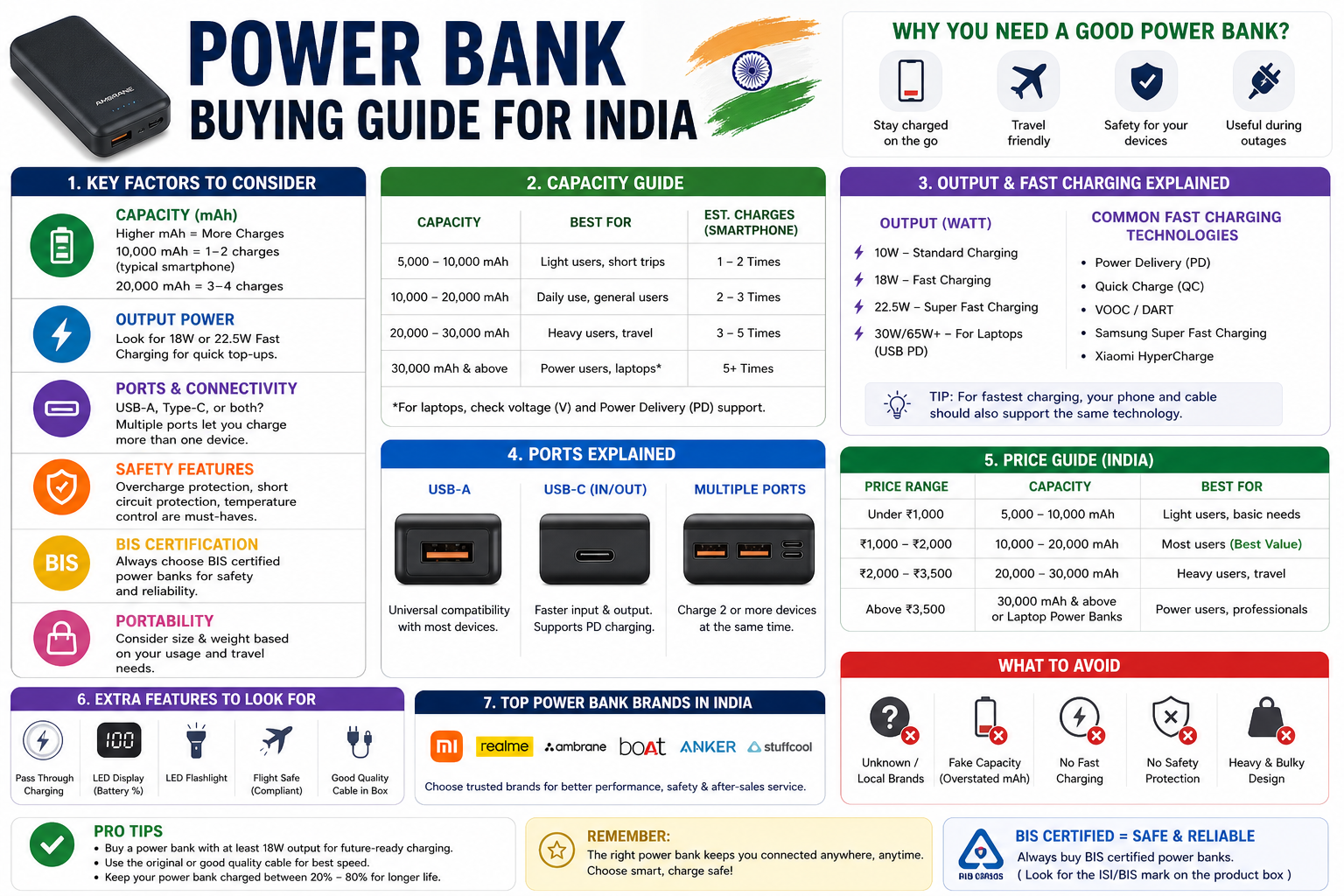
Power banks seem like a simple purchase. Battery capacity. Number of ports. Maybe a charging speed. Pick the biggest number that fits your budget, done.
Except it’s not that simple — and the Indian market specifically makes it more complicated. BIS certification requirements, airline carry-on restrictions, actual vs. advertised capacity, and the difference between marketing watt-hours and real-world charges are all things that matter. Buy wrong and you have a power bank that delivers half the charges it promises, takes six hours to refill itself, or gets confiscated at airport security.
This guide gives you the full picture — based on years of testing power banks across Indian travel, outdoor use, and daily carry scenarios.
The Capacity Deception: Why Your 20,000 mAh Power Bank Gives Far Fewer Charges Than You Expect
The most common disappointment with power banks is capacity. Someone buys a 20,000 mAh power bank and expects it to charge their 4,500 mAh phone four times. They get two and a half. They assume they were sold a fake.
They weren’t (necessarily). The math is just misleading in multiple ways:
Reason 1: Voltage conversion loss. Power bank batteries store energy at 3.7V. Your phone charges at 5V. Converting between voltages loses energy — typically 10–20% depending on the quality of the conversion circuitry.
Reason 2: Cable and connection resistance. Energy is lost as heat in the charging cable, connector, and your phone’s charging circuitry. Higher quality cables with lower resistance lose less.
Reason 3: Your phone’s battery is also not at rated capacity. If your phone is 2 years old, its actual battery may only hold 85–90% of its nominal capacity. Charging from 10% to 100% on a degraded battery takes less energy than the label suggests — but you’re not getting more charges either.
The realistic conversion factor: Quality power banks deliver approximately 60–70% of their rated capacity as usable charge to your phone. A genuine 20,000 mAh power bank (at 3.7V internal) realistically provides about 12,000–14,000 mAh at 5V to your device.
What this means practically:
- 20,000 mAh power bank → approximately 3–4 full charges of a 4,000 mAh phone
- 10,000 mAh power bank → approximately 1.5–2 full charges of a 4,000 mAh phone
- 5,000 mAh power bank → approximately 1 full charge, possibly 1.2x
Factor this into your buying decision. If you need four full charges, you need a power bank rated at 25,000–30,000 mAh — not 20,000.
BIS Certification: Don’t Skip This in India
The Bureau of Indian Standards (BIS) certification is mandatory for power banks sold in India. Since 2022, BIS registration has been enforced more strictly, and power banks without BIS certification are legally non-compliant and often fail safety standards.
Why does this matter for you as a buyer? Uncertified power banks (common on Instagram shops, WhatsApp commerce, and some Meesho sellers) frequently use:
- Cells that don’t match the rated capacity (a common scam is 18650 cells rated at 2,600 mAh stuffed into a case claiming 10,000 mAh — three cells × 2,600 = 7,800 mAh, not 10,000)
- Absent or inadequate protection circuits (overcharge, over-discharge, short-circuit protection are critical for lithium-ion safety)
- Poor heat management that degrades cells quickly
How to verify BIS certification: Legitimate BIS-certified power banks display the BIS R-Number on the product packaging and often on the device itself. You can verify the registration at the BIS portal (bis.gov.in/bis-care/). Brands like Anker, MI (Xiaomi), Ambrane, Syska, Portronics, and Realme all maintain current BIS certifications for their Indian products.
Airline Rules: The Capacity Limits That Will Get Your Power Bank Confiscated
If you travel by air — domestic or international — power bank rules are non-negotiable. The DGCA (Directorate General of Civil Aviation) follows IATA (International Air Transport Association) guidelines:
Rules as of 2026:
- Power banks are not allowed in checked baggage under any circumstances. They must travel in carry-on only.
- Power banks up to 100 Wh (watt-hours): Allowed in carry-on, no approval needed
- Power banks 100 Wh to 160 Wh: Allowed in carry-on with airline approval (ask at check-in)
- Power banks above 160 Wh: Not permitted on passenger aircraft
How to calculate Wh from mAh: Wh = (mAh × V) / 1,000. For lithium-ion power banks at 3.7V:
- 10,000 mAh × 3.7V / 1,000 = 37 Wh ✅ Well within limits
- 20,000 mAh × 3.7V / 1,000 = 74 Wh ✅ Within limits
- 27,000 mAh × 3.7V / 1,000 = 99.9 Wh ✅ Just within 100 Wh limit
- 30,000 mAh × 3.7V / 1,000 = 111 Wh ⚠️ Requires airline approval
If you frequently fly, stay under 27,000 mAh (approximately 100 Wh) to avoid complications.
Many power banks now display their Wh rating directly on the label — look for it.
Fast Charging: What the Numbers Mean and What You Actually Need
Power banks now advertise charging speeds in watts. This is more meaningful than mAh for understanding how fast your phone charges, but it comes with its own set of confusions.
Input wattage — how fast the power bank itself recharges (from a wall adapter):
- 5W: Extremely slow. A 20,000 mAh bank takes 12+ hours to refill. Avoid.
- 18W: Decent. A 20,000 mAh bank refills in 5–6 hours.
- 22.5W or 33W: Good. A 20,000 mAh bank refills in 3.5–4.5 hours.
- 65W+: Fast. A 20,000 mAh bank can refill in under 3 hours.
Output wattage — how fast the power bank charges your phone:
- 10W: Standard, charges most phones at their default speed
- 18W: Fast charge for most Android phones (Qualcomm Quick Charge 3.0)
- 22.5W: Supports faster charging for Xiaomi, Realme, Poco phones
- 65W: Required for laptops, MacBooks, and USB-C devices that support Power Delivery
The standard vs. PD (Power Delivery) distinction: Standard fast charging (Qualcomm Quick Charge) and USB Power Delivery are different protocols. A power bank advertising “18W fast charge” may only support QC — which charges Samsung and Xiaomi phones quickly but won’t fast charge a MacBook or iPad Pro, which require USB-PD.
If you want to charge a laptop from a power bank, you need a PD-capable power bank with at least 45W output. For MacBooks, you need 60W–100W PD.
Recommended Power Banks for Indian Users (2026)
For Daily Carry (Commute, Office): 10,000 mAh
MI Power Bank 3i 10000 mAh — ₹999–₹1,199 The most consistently reliable budget power bank in India. 18W fast charge output, 22.5W input (with a compatible adapter), dual USB-A ports, USB-C. Slim form factor fits in most trouser pockets. BIS certified. Ships from Xiaomi’s Indian manufacturing. This is the recommendation for anyone who wants one charge on the go without carrying a brick.
Anker PowerCore Slim 10000 PD — ₹1,999–₹2,499 More expensive but adds USB-PD support and a significantly slimmer profile (thinner than most smartphones). If you also carry a Nintendo Switch, iPad, or any USB-C device that benefits from PD, this is worth the premium.
For Frequent Travellers (Flight, Weekend Trips): 20,000 mAh
MI Power Bank 3 20000 mAh (PD version) — ₹1,799–₹2,199 Xiaomi’s 20,000 mAh flagship in this range. 50W input (fast self-recharge), 22.5W output. Two USB-A and one USB-C port. Lightweight for its capacity at 440g. The most recommended power bank in this category on the basis of value and reliability — I’ve used this personally on domestic flights and 3-day trips without issues.
Ambrane 20000 mAh with 20W PD — ₹1,299–₹1,599 Good value Indian brand, BIS certified, decent build quality. Not quite the same cell quality as MI but a solid budget option if the MI is out of stock.
For Heavy Users and Laptop Charging: 25,000–30,000 mAh
Anker 737 Power Bank (24,000 mAh, 140W) — ₹8,999–₹11,999 Premium option. 140W output can charge a MacBook Pro at nearly full speed. Smart display shows remaining battery percentage, input/output wattage in real time. Heavy at 642g but the most capable power bank in India for professionals who need to power laptops and phones simultaneously. Airport-safe at under 89 Wh despite the 24,000 mAh label (Anker calculates at 3.7V × 24,000 / 1,000 = 88.8 Wh).
Realme 30W Dart Power Bank 30000 mAh — ₹1,999–₹2,499 Budget option for high capacity. The 30W charging speed is slower than premium options but the price is hard to argue with. Note the 30,000 mAh × 3.7 / 1,000 = 111 Wh — this requires airline approval for carry-on. If you fly frequently, stick to a 27,000 mAh or lower option.
For Trekking and Outdoor Use: Solar Power Banks
Solar power banks occupy a separate category. They are useful for multi-day treks and camping in India where grid power is genuinely unavailable — but they are not faster or better than regular power banks for daily use.
Reality of solar charging: A typical budget solar panel on a power bank generates 2W in direct Indian sunlight. Charging a depleted 10,000 mAh bank via solar alone takes 30–50 hours of direct sunlight. Solar is a supplemental trickle-charge, not a primary charging method.
Buy solar banks for: Multi-day Himalayan or forest treks where you need emergency supplemental charging and can’t carry a charger.
Don’t buy solar banks for: Daily city use, replacing a regular power bank, or situations where you have access to wall power.
Recommended for treks: Xtorm Solar Charger (authentic imported brands with proven solar cells) or Mi Outdoor Power Bank 30000 mAh if you’re okay with the airline weight restriction.
The Fake Power Bank Problem in India
Instagram, Facebook Marketplace, WhatsApp groups, and some Meesho sellers sell power banks that are entirely fake in their capacity claims. A “20,000 mAh” unit that gives one charge of a small phone is a classic tell.
How to test if your power bank is genuine:
- Time how long it takes to charge a fully dead phone from 0% to 100%
- A 4,500 mAh phone battery charging at 10W should take approximately 2.5–3 hours
- Count how many full charges you get from the power bank before it’s depleted
- Multiply: number of charges × phone battery capacity = approximate actual capacity at device
- Compare against the stated capacity (accounting for the 60–70% conversion factor discussed earlier)
If you get significantly fewer than expected: you were sold a misrepresented product. You can file a consumer complaint on the National Consumer Helpline (NCH) at consumerhelpline.gov.in, or raise a dispute through the platform you bought it from.
Summary: How to Choose
- Daily commute, one-charge buffer → MI Power Bank 3i 10,000 mAh (~₹1,000)
- Weekend travel, frequent flyer → MI Power Bank 3 20,000 mAh PD (~₹2,000)
- Laptop + phone together → Anker 737 140W (~₹10,000)
- Himalayan trekking → MI Outdoor 30,000 + own wall charger for base camps
- Gift for parents/senior family member → MI 10,000 mAh 3i — simple, reliable, BIS certified, easy to use
Always buy from Amazon India (Fulfilled by Amazon listing), Flipkart (brand-sold listing), or the brand’s own website. Avoid third-party sellers for electronics.
Prices are indicative as of April 2026. Power bank regulations and airline policies are subject to change — always verify DGCA guidelines before travel. BIS certification status can be verified at bis.gov.in.

