
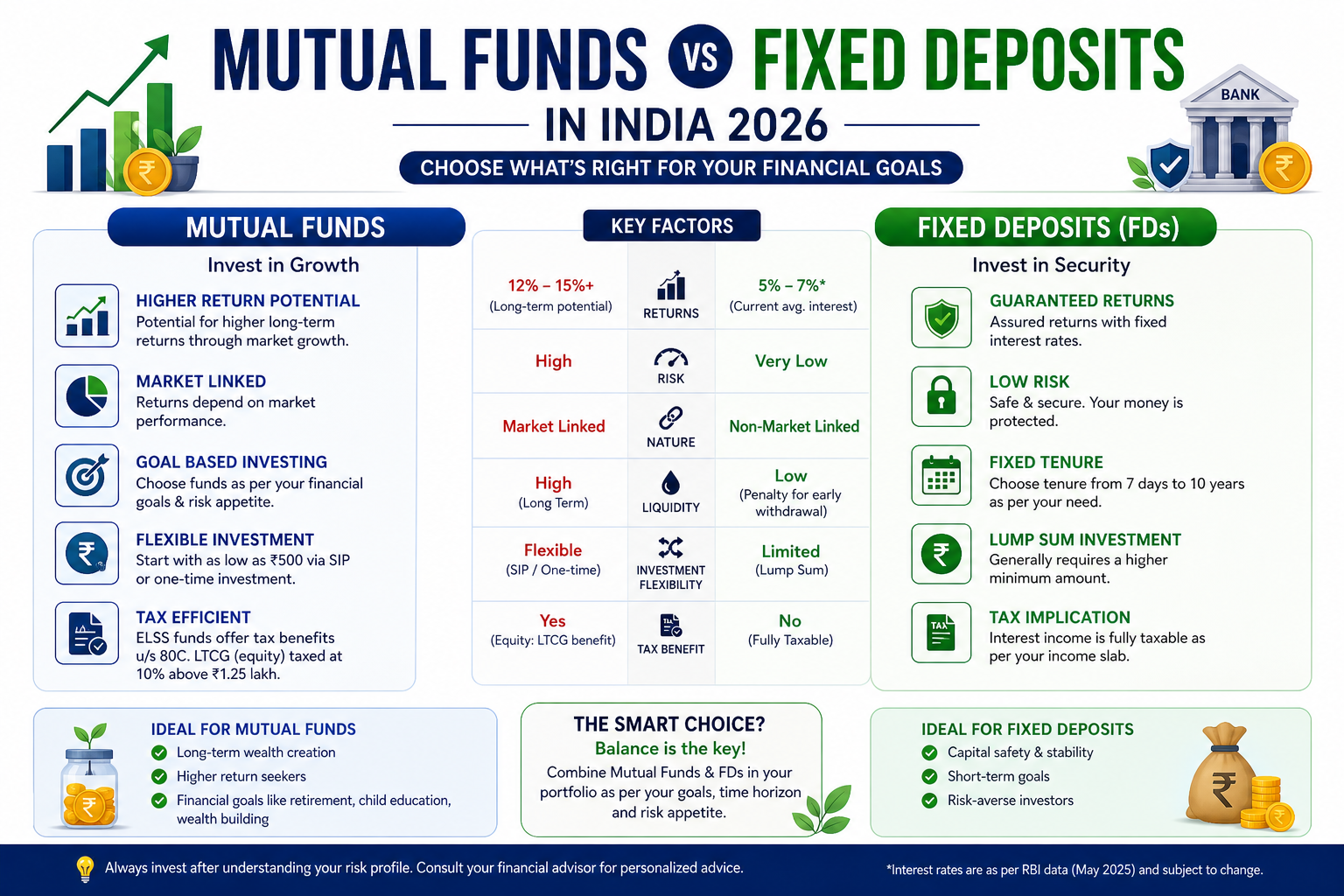
Every Indian family has the same argument. One person wants to put the money in an FD — safe, guaranteed, predictable. The other wants to invest in mutual funds — better returns, but “what if the market crashes?” Both are right about something. Both are also missing something.
This is not a generic comparison article. This is a ground-level look at how FDs and mutual funds actually perform in the Indian context in 2026, what the tax treatment means for your real returns, and how to think about which belongs in your portfolio — with real numbers, not vague guidance.
The Fundamental Difference Nobody Explains Clearly
A Fixed Deposit is a loan you give to a bank. The bank takes your money, uses it for its own lending activities, and pays you a fixed interest rate regardless of what happens to markets. Your risk is essentially limited to the bank going under — which is why RBI’s Deposit Insurance and Credit Guarantee Corporation (DICGC) insures up to ₹5 lakh per depositor per bank.
A Mutual Fund is pooled ownership. When you invest ₹10,000 in a mutual fund, that money buys units in a fund that owns a basket of assets — stocks, bonds, or both. If those assets grow in value, your units grow. If they fall, your units fall. The fund manager (in actively managed funds) or the index itself (in passive/index funds) determines what gets bought and sold. Your risk is market risk, not bank failure risk.
This distinction matters because the type of risk is completely different, not just the amount of risk.
FD Interest Rates in India: Where They Stand in 2026
After the RBI’s rate cycle that pushed repo rates to 6.5% in 2023 and held them there through much of 2024-25, FD rates for retail depositors are in a reasonably attractive range compared to the 2020-21 pandemic lows.
As of early 2026, indicative FD rates for general citizens (non-senior) on 1–3 year tenures from major banks:
- SBI: approximately 6.80% – 7.00% per annum
- HDFC Bank: approximately 7.00% – 7.25% per annum
- ICICI Bank: approximately 7.00% – 7.25% per annum
- Axis Bank: approximately 7.10% – 7.25% per annum
- Small Finance Banks (AU, ESAF, Ujjivan): 8.00% – 9.00% per annum (higher rate, higher institutional risk)
Senior citizens typically get an additional 0.25% to 0.50% on these rates.
The critical point most people miss: These are pre-tax rates. The interest you earn on FDs is added to your income and taxed at your income tax slab. If you’re in the 30% tax bracket, a 7.25% FD gives you an effective post-tax return of approximately 5.07% per annum. After accounting for inflation (which RBI targets at 4% and which in practice runs around 4.5–5.5% in India), your real purchasing power gain from an FD in the highest tax bracket is close to zero or slightly negative.
This is the FD reality that bank advertisements never show you.
Mutual Fund Returns: What the Data Actually Shows
Mutual funds in India have produced returns that vary significantly by category. Let’s look at actual long-term data rather than cherry-picked best-case scenarios.
Large-cap equity funds (funds investing in India’s top 100 companies by market cap) have historically delivered 10–13% CAGR over 10-year periods, though individual years show extreme variance. In years like 2020 (COVID crash), large-cap funds lost 25–30% in a matter of weeks. By December 2020, they had recovered and gained. Investors who panicked and redeemed in March 2020 locked in real losses.
Index funds tracking Nifty 50 have delivered approximately 12–13% CAGR over the last 15 years. As of 2025-26, the expense ratios on direct-plan Nifty 50 index funds from AMCs like UTI, HDFC, and Nippon are as low as 0.10–0.20% — making them among the most cost-efficient investment vehicles available to Indian retail investors.
Debt mutual funds (funds investing in bonds and money market instruments) have historically delivered 6–8% returns, but their tax treatment changed significantly after April 2023. More on this below.
Hybrid funds (Balanced Advantage Funds, Aggressive Hybrid Funds) have delivered 9–11% over long periods by dynamically adjusting between equity and debt exposure.
The Tax Comparison: Where FD vs Mutual Fund Becomes a Real Decision
This is the section that changes the math entirely.
FD Taxation
FD interest is taxed as ordinary income — it’s added to your gross income and taxed at your applicable slab rate. If you earn ₹15 lakh annually and earn ₹50,000 in FD interest, that ₹50,000 is taxed at 30% (plus cess). Effective tax on interest: approximately ₹15,600.
Additionally, banks deduct TDS (Tax Deducted at Source) at 10% on FD interest exceeding ₹40,000 per year (₹50,000 for senior citizens) — though you claim this against your actual tax liability at filing time.
Equity Mutual Fund Taxation (2024 Budget Changes)
The Union Budget 2024 changed the tax structure for equity mutual funds. As of the updated rules:
- Short-term capital gains (STCG): Units sold within 12 months — taxed at 20% (increased from 15% in Budget 2024)
- Long-term capital gains (LTCG): Units sold after 12 months — gains above ₹1.25 lakh per year taxed at 12.5% (increased from 10%, exemption limit raised from ₹1 lakh to ₹1.25 lakh in Budget 2024)
The ₹1.25 lakh LTCG exemption per year is meaningful for moderate investors. If your total long-term equity gains in a year are ₹1.25 lakh or less, you pay zero tax on them.
Debt Mutual Fund Taxation (Post April 2023 Change)
After April 1, 2023, debt mutual funds lost their indexation benefit. Gains from debt mutual funds are now taxed at the investor’s income tax slab rate — exactly the same as FD interest. This eliminated the tax advantage that debt funds previously held over FDs for higher-bracket investors.
This is why, for purely fixed-income allocation, the tax argument for debt mutual funds over FDs largely evaporated in 2023. However, liquid funds, overnight funds, and short-duration funds still offer better liquidity than FDs with comparable tax treatment.
Liquidity: The Hidden Cost of FDs
This is the practical difference that matters most in real-life financial emergencies.
An FD, once created, locks your money for the tenure. Breaking an FD early typically costs you a 0.50% to 1% penalty on the interest rate. If you created a 3-year FD at 7.25% and need to break it after 8 months, you might receive only 5.75–6.00% for the period held — and your emergency has still disrupted your financial plan.
A liquid mutual fund, by contrast, can be redeemed within one business day (T+1 settlement) with no exit load after 7 days of investment. Some funds offer even faster redemption through “instant redemption” features up to ₹50,000 or 90% of the folio value.
This liquidity difference is critical for emergency funds. Keeping your 6-month emergency fund in an FD creates a perverse situation where the moment you need the money most — job loss, medical emergency — you have to break the FD and pay a penalty. A liquid fund or an ultra-short duration fund solves this.
The Right Way to Think About FD vs Mutual Fund: It’s Not Either/Or
The question “FD or Mutual Fund?” is usually the wrong question. The right question is: what is this money for, and what time horizon does it have?
Here’s a practical framework for Indian investors in 2026:
Money you’ll need within 1 year (Emergency fund, upcoming expense): Use a savings account, liquid fund, or short-duration debt fund. Not equity mutual funds. Not long-term FDs that penalise early withdrawal.
Money you won’t need for 3–5 years (Medium-term goals: car, home down payment, child’s school fees): A combination approach works well. A portion in FD (for certainty), a portion in a balanced advantage fund or short-to-medium duration debt fund (for slightly better expected return with manageable risk).
Money you won’t need for 7+ years (Long-term goals: retirement, child’s college education, wealth building): Equity mutual funds, particularly Nifty 50/Nifty 500 index funds with low expense ratios, have the strongest track record over long horizons in India. The power of compounding works overwhelmingly in equities’ favour over 15–20 year periods.
Tax-saving (Section 80C, up to ₹1.5 lakh deduction): ELSS (Equity Linked Savings Scheme) mutual funds offer the same 80C deduction as 5-year tax-saving FDs, but with a shorter lock-in period of 3 years (vs 5 years for FD) and equity-level return potential. For most investors under age 50, ELSS is a superior choice to the 5-year tax-saving FD — unless market volatility causes anxiety that leads to poor decisions.
The Behavioural Reality: Why FDs Work for Some People
It’s worth being honest about this. The theoretical superiority of equity mutual funds over FDs over long periods is real. But theoretical returns and actual investor returns are different things.
Research on Indian mutual fund investors consistently shows that many investors buy equity funds at market highs (when returns look great and everyone is talking about stocks), panic and redeem at market lows (when portfolios are down 25%), and then stay in FDs until the market recovers — at which point they re-enter near the top again.
The sequence of buy-high, sell-low, repeat destroys returns. An investor who stuck with a 7% FD for 15 years and never deviated from the plan may actually have better real outcomes than an investor who theoretically invested in equity funds but redeemed every time markets fell.
The best investment is the one you can stay invested in through discomfort. If market volatility causes you to lose sleep and make reactive decisions, a hybrid approach (or even a primarily FD-based approach) that keeps you invested is better than a theoretically optimal equity portfolio that you’ll abandon at the worst moment.
Practical Steps to Start in 2026
If you want to start with mutual funds for the first time:
- Open an account on any of the major direct plan platforms — Zerodha Coin, Groww, Paytm Money, or directly through the AMC website (e.g., utimf.com, hdfcfund.com)
- Complete your KYC (one-time process using Aadhaar and PAN)
- Start with a Nifty 50 Index Fund via SIP (Systematic Investment Plan) — ₹500/month is enough to begin
- Set the SIP date 2-3 days after your salary credit date so money moves automatically
- Don’t check the portfolio more than once a month. Ideally, less.
If you want to continue with FDs but improve your returns:
- Compare FD rates across banks on platforms like BankBazaar or Paisabazaar before locking in
- Consider staggering FDs (FD ladder) — instead of one large 3-year FD, create three FDs of equal amount with 1-year, 2-year, and 3-year maturities. This gives you periodic liquidity and lets you reinvest at current rates as each matures.
- Senior citizen in your family? FD rates for senior citizens are 0.25–0.50% higher. If appropriate, consider whether routing some investment through them (with proper documentation) makes tax sense.
The Bottom Line
Fixed Deposits are not bad. They’re predictable, insured up to ₹5 lakh, and require zero monitoring. For people who genuinely cannot tolerate uncertainty, for short-term goals, and for the “sleep well at night” portion of your money, FDs make sense.
Mutual funds — particularly equity index funds over long horizons — have a strong mathematical advantage over FDs for wealth creation. But that advantage only materialises if you stay invested through market downturns and don’t redeem at the wrong time.
The answer for most Indians in 2026 isn’t FD or mutual fund. It’s a deliberate allocation across both based on your timeline, tax bracket, risk tolerance, and the specific purpose of each rupee you’re investing.
Know what the money is for. Then choose the right tool.
This article is for educational purposes and does not constitute personalised financial or investment advice. Market returns are subject to risk. Consult a SEBI-registered investment adviser for personalised guidance. Tax rules are based on Union Budget 2024 provisions and are subject to change.

