
Most Indians know UPI as the tap-and-pay system that killed the need for cash. PhonePe, Google Pay, Paytm — open any of these apps and money moves instantly. But since 2023, a quieter change has been building inside UPI that most people haven’t fully understood yet: the ability to spend money you don’t have in your bank account — directly from your UPI app.
It’s called UPI Credit Line (officially “Credit Line on UPI” under RBI’s framework), and it’s one of the most significant changes to how Indians can borrow money in everyday life. It’s also one of the most misunderstood.
This guide explains exactly what it is, how it works technically, which banks offer it, what it actually costs, and the honest risks you need to understand before using it.
What Is UPI Credit Line? The Plain-Language Explanation
When you pay via UPI normally, the money is pulled from your linked savings or current account. The balance goes down. Simple.
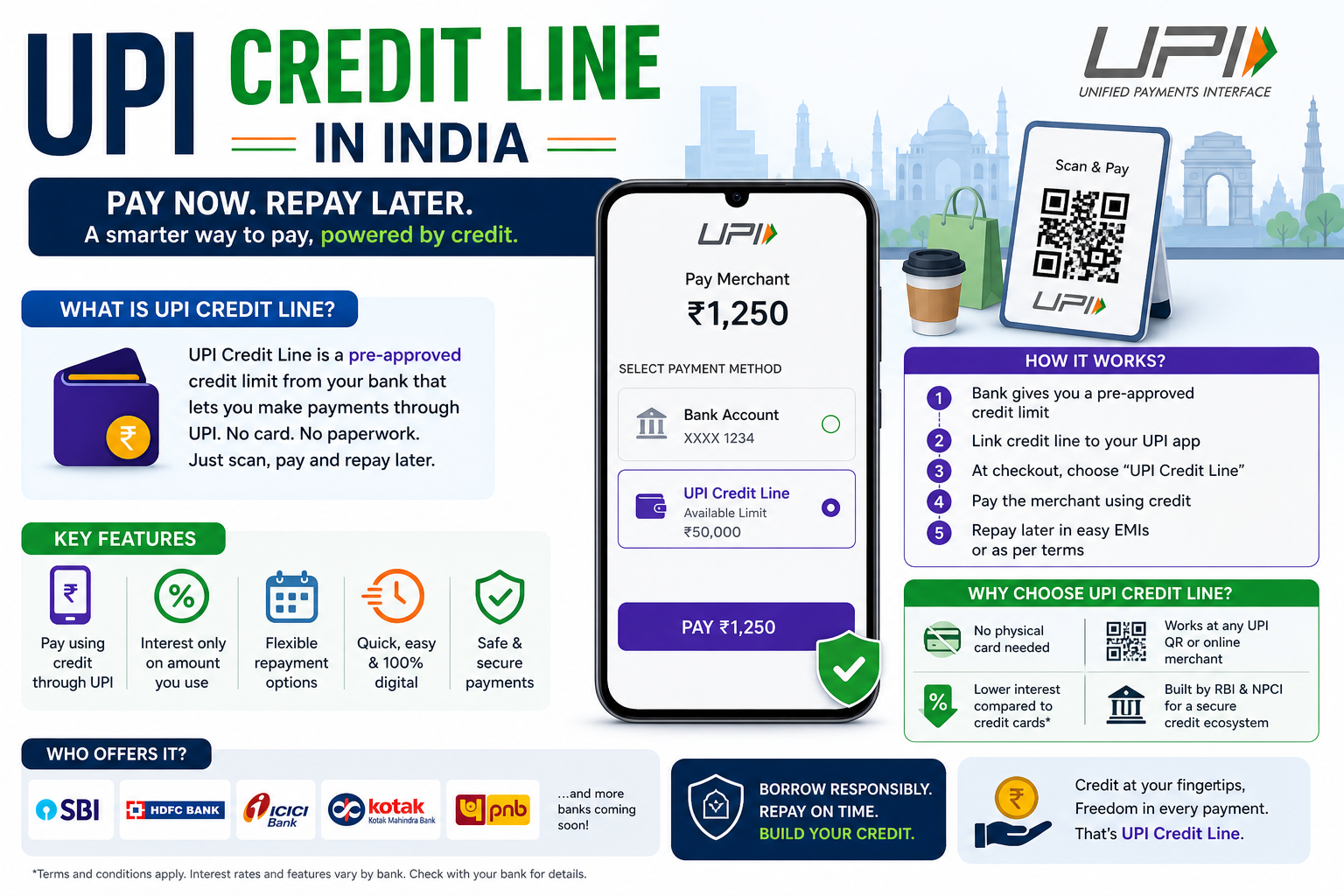
UPI Credit Line works differently. Instead of pulling from your bank savings, it pulls from a pre-approved credit facility — essentially a small loan — that your bank has already sanctioned for you. You spend now. The bank settles with the merchant. You repay the bank later.
Think of it as a credit card, but one that works through your existing UPI app without needing a physical card. You see the credit limit inside PhonePe or Google Pay, you choose to pay from it, and the transaction goes through exactly like a normal UPI payment — QR code scan, UPI PIN, done.
The RBI enabled this in September 2023 by allowing banks to link pre-sanctioned credit lines to UPI. Before that, UPI was strictly tied to bank accounts only. This was a deliberate policy change to extend credit access to more Indians, including many who have bank accounts but no credit cards.
How It Actually Works: The Technical Flow
Understanding the flow helps you understand both the opportunity and the risk.
Step 1 — Bank pre-sanctions a credit limit for you. Based on your banking history, income, credit score (CIBIL/Experian), and account behaviour, your bank decides you qualify for, say, ₹50,000 in credit. This may happen proactively (the bank notifies you) or you may need to apply inside your banking app.
Step 2 — You link the credit line to your UPI app. Inside Google Pay, PhonePe, or your bank’s own UPI app, you add the credit line as a payment source. It appears alongside your debit-linked bank accounts.
Step 3 — At the time of payment, you select the credit line. When you scan a QR code or enter a UPI ID, you choose whether to pay from your savings account or from the credit line. Enter your UPI PIN. Transaction goes through.
Step 4 — Repayment. You repay the credit used within the billing cycle — typically 30 to 45 days. If you repay in full, many banks charge zero interest. If you carry a balance, interest applies — and this is where you need to read the fine print carefully.
Which Banks Are Currently Offering UPI Credit Line in India?
As of 2026, the following major banks have rolled out credit line on UPI to varying degrees:
HDFC Bank was among the first to integrate this feature, linking it to their HDFC PayZapp and through Google Pay. Existing HDFC credit card holders and select savings account customers have been offered credit lines ranging from ₹10,000 to ₹5 lakh depending on their profile.
ICICI Bank offers credit line on UPI through their iMobile Pay app and has tied it to their existing credit card infrastructure. Customers who already have an ICICI credit card may find the feature already available inside their UPI interface.
Axis Bank rolled this out in partnership with BHIM UPI and their own app. Axis also tested a Buy Now Pay Later (BNPL) variant of this feature where smaller amounts could be split across 3 months.
State Bank of India (SBI) has been slower to deploy this compared to private banks but has piloted it for select YONO users with existing credit relationships with the bank.
Kotak Mahindra Bank and IndusInd Bank have also entered this space, particularly targeting their existing personal loan and credit card customers.
Fintech-backed credit lines — companies like slice, LazyPay, and KreditBee have also launched credit lines accessible via UPI, though these are technically non-bank credit and come with different (often higher) interest rate structures.
Important: Availability depends on your specific bank, your existing relationship with them, your credit score, and your income profile. Not everyone gets offered this feature. If you don’t see it in your UPI app, it means either your bank hasn’t launched it yet or you don’t meet their eligibility criteria.
What Does UPI Credit Line Actually Cost?
This is the section most articles gloss over. Don’t skip it.
If you repay within the interest-free period: Most banks offer 30 to 50 interest-free days. If you spend ₹15,000 on April 5 and your billing cycle closes April 30, you have until approximately May 20 to repay the full ₹15,000 with zero interest. This works exactly like a credit card.
If you carry a balance: Interest rates on UPI credit lines in India typically range from 18% to 42% per annum, depending on your bank and credit profile. This is not negligible. A ₹20,000 balance carried for 3 months at 36% annual interest costs you approximately ₹1,800 in interest — more than most people realise when the transaction feels as casual as a UPI payment.
Processing fees: Some banks charge a one-time processing fee to activate the credit line (typically ₹500 to ₹1,000). Others have no activation fee for existing customers.
Late payment charges: If you miss your repayment due date, late fees typically range from ₹250 to ₹750 plus GST, and the missed payment gets reported to credit bureaus, which will hurt your CIBIL score.
Minimum due trap: Like credit cards, UPI credit lines show a “minimum due” amount that is much smaller than the full outstanding. Paying only the minimum keeps you compliant but doesn’t stop interest from accumulating on the remaining balance. This is the most common way people fall into debt spirals with revolving credit.
The Real Benefits: Who Should Actually Consider This
UPI Credit Line is genuinely useful in specific situations. It’s not a product to fear, but it’s also not for everyone.
Best use case 1 — Short-term cash flow gaps. Your salary comes on the 5th but a large bill is due on the 28th. Rather than breaking a fixed deposit or borrowing from family, a UPI credit line bridges that gap at zero cost if repaid within the billing cycle. This is the classic credit card use case applied to UPI.
Best use case 2 — Building a credit history. India has over 300 million people with a bank account but no credit history. No credit history means no access to loans at good interest rates. Using a UPI credit line responsibly — spending small amounts, repaying in full each month — builds a CIBIL score the same way a credit card does, often with lower barriers to entry.
Best use case 3 — Emergency purchases with repayment capacity. Your laptop dies before a critical project deadline. You have the salary coming in 10 days. A credit line purchase buys you the laptop now at zero interest if repaid on time.
Who should NOT use this: If you regularly spend more than you earn, if you have existing high-interest debt, or if you tend to pay only the minimum due on credit cards — a UPI credit line is the same trap with a more accessible entry point.
Risks You Must Understand Before Activating
Risk 1 — It feels like UPI, but it’s debt. The psychological problem with UPI Credit Line is that it looks and feels exactly like a normal UPI payment. The same QR code. The same PIN. The same ₹ symbol. This familiarity removes the friction that makes people think twice before spending on credit. Multiple studies on consumer behaviour show that lower-friction credit leads to higher spending. Be aware of this.
Risk 2 — Impact on your CIBIL score. Every use of your credit line is reported to credit bureaus. High credit utilisation (spending more than 30% of your credit limit) consistently suppresses your CIBIL score even if you repay on time. If you’re planning to apply for a home loan in the next 12–18 months, keep credit utilisation low.
Risk 3 — Fintech credit lines carry higher risk. Credit lines from BNPL fintech companies (not scheduled banks) may not follow the same RBI consumer protection guidelines. Check whether your credit line provider is a bank or an NBFC, and read the grievance redressal mechanism carefully. In case of disputes, bank-backed credit lines have clearer escalation paths.
Risk 4 — Autopay failures. If you set up autopay for credit line repayment and your savings account doesn’t have sufficient balance on the due date, the repayment bounces, you get a late fee, and it gets reported negatively. Always ensure your autopay source has a buffer.
How to Use UPI Credit Line Responsibly: A Practical Framework
If you decide to use this feature, these rules will keep you on the right side of it:
The “salary buffer” rule: Never use your credit line for an amount you couldn’t pay back from your next salary alone. If your salary is ₹40,000, don’t carry a credit line balance of more than ₹40,000 at any time.
The “full payment only” rule: Set your repayment to “Pay Full Outstanding” not “Pay Minimum Due.” Make this your non-negotiable default. Interest-free credit is a powerful tool; revolving credit at 36% APR is an expensive trap.
The “statement check” habit: Check your credit line statement at least once a week, the same way you’d check your UPI transaction history. Catching an error or an unexpected charge early is far easier to resolve than discovering it after the billing cycle closes.
The “30% utilisation cap” rule: If your credit limit is ₹1 lakh, try not to have more than ₹30,000 outstanding at any time. This protects your credit score even if you repay in full.
What to Do Right Now
If you want to check whether UPI Credit Line is available to you:
- Open your Google Pay or PhonePe app
- Go to “Payment Methods” or “Manage Accounts”
- Look for an option to “Add Credit Line” or “View Credit Offers”
- If available, your bank will show the pre-approved limit and terms
If it’s not available yet, you can proactively check inside your bank’s own app (HDFC MyCards, ICICI iMobile Pay, SBI YONO) under credit or loans sections.
Before activating, read the Key Fact Statement that RBI mandates all lenders to provide. It will clearly state the interest rate, fees, billing cycle, and grievance mechanism in plain language.
The Bottom Line
UPI Credit Line is a genuinely useful financial tool for disciplined borrowers. It extends credit access to millions of Indians who were previously locked out of the credit system, and it does so through an interface people already trust and use daily.
But convenience and risk are two sides of the same coin here. The easier credit is to access, the easier it is to misuse. Understanding how it works — technically, financially, and psychologically — is the difference between using it as a bridge and using it as a trap.
Use the interest-free period. Pay in full. Watch your utilisation. And never confuse the familiarity of a UPI payment with the absence of debt.
This article is for educational purposes only and does not constitute financial advice. Interest rates and product features vary by bank and are subject to RBI regulatory changes. Always read the product terms before activating any credit facility.

